
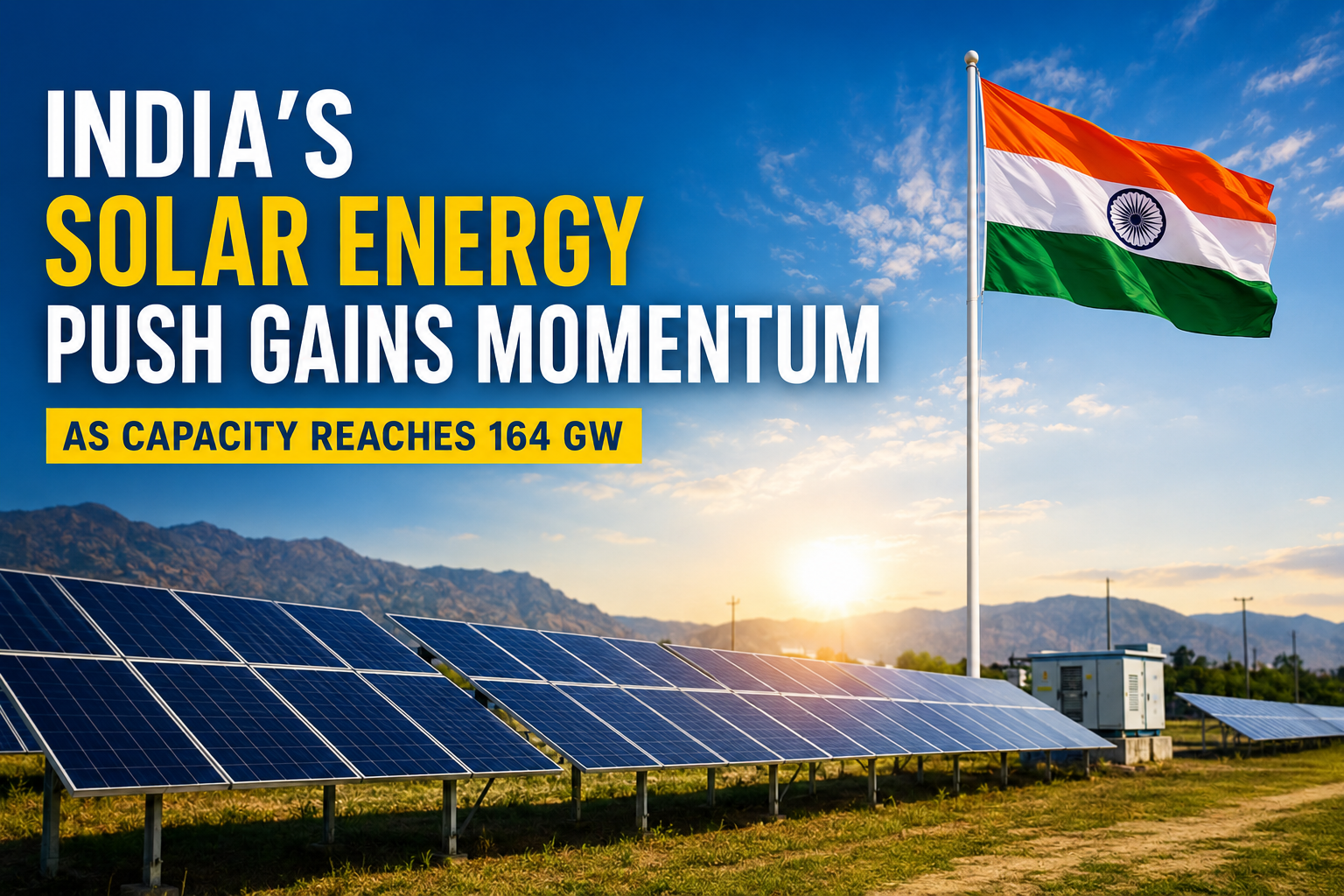
New Delhi: India’s solar energy sector continues to expand rapidly, strengthening the country’s position in the global renewable-energy market. According to the Ministry of New and Renewable Energy (MNRE), India had reached 164.59 GW of installed solar power capacity by July 31, 2026. Solar power has now become the largest component of India’s renewable-energy capacity.
The growth represents a dramatic increase from 2014, when India had only around 2.8 GW of installed solar capacity. The government has been encouraging solar projects through large-scale utility developments as well as rooftop installations for households and businesses.
The rooftop segment is also showing strong growth. India added approximately 6.6 GW of rooftop solar capacity during the first half of 2026, more than double the capacity installed during the same period in 2025. Residential consumers accounted for the majority of new rooftop installations, supported by the PM Surya Ghar programme.
The government says millions of households are already benefiting from rooftop solar installations. Under PM Surya Ghar, more than 51 lakh households had installed rooftop systems by August 12, 2026, while nearly 19 lakh households were reported to be receiving zero electricity bills.

However, India’s rapid solar expansion is also creating new challenges. A recent report highlighted that nearly 11 terawatt-hours of solar electricity was curtailed over the past 15 months, mainly because of grid limitations, transmission constraints and insufficient storage capacity.
Experts say India will need greater investment in transmission networks, battery storage and flexible power systems to ensure that growing solar generation can be used efficiently.
Despite these challenges, the latest figures show that solar energy is becoming an increasingly important part of India’s electricity system. With continued investment in renewable infrastructure, rooftop systems, storage and domestic manufacturing, solar power is expected to play a central role in India’s long-term energy transition.
