
Table of Contents
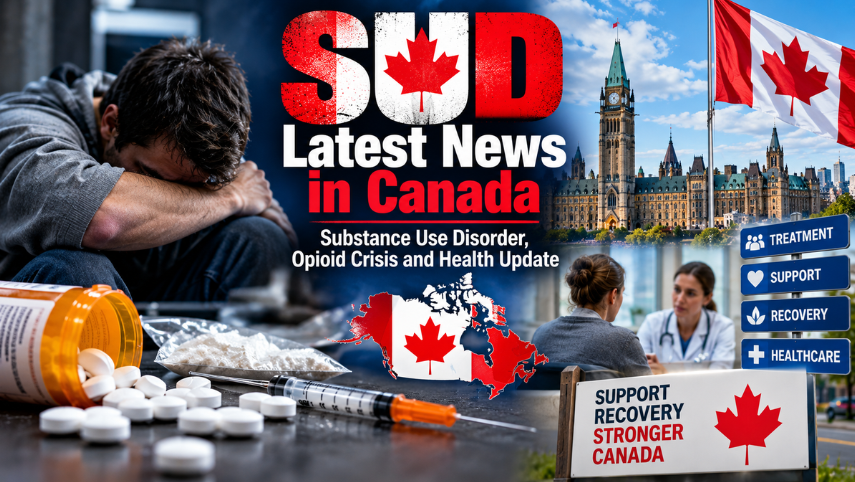
SUD latest news Canada: Substance use disorder (SUD) remains an important public-health issue across Canada as governments, healthcare providers and communities continue to respond to opioid-related harms, stimulant use and barriers to treatment. Recent national data show that substance-related deaths remain above pre-pandemic levels, although opioid-related deaths declined in 2025 compared with the previous year.
The issue is also receiving renewed attention because Canadian health organizations are expanding guidance for healthcare professionals and improving access to prevention, treatment, harm-reduction and recovery services.
What Does SUD Mean?
SUD stands for substance use disorder. It describes a health condition in which a person’s use of a substance causes significant problems or difficulty controlling use.
SUD can involve different substances, including alcohol, opioids, stimulants and other drugs. The condition can affect physical health, mental health, relationships, employment and everyday life.

Canadian health organizations increasingly describe substance use as a health issue rather than simply a criminal or social problem. The Mental Health Commission of Canada notes that substance-use health exists on a spectrum and can be closely connected with mental health.
Canada SUD News Today: Latest Data
The latest federal data provide a mixed picture of Canada’s substance-related crisis.
According to the Public Health Agency of Canada, there were 5,608 opioid-related deaths in 2025, averaging approximately 15 deaths per day. This represented a 23% decrease from 2024, but the federal government stressed that the number remains a serious public-health concern.
Health Canada continues to publish updated information covering opioid and stimulant toxicity deaths, hospitalizations, emergency-department visits and emergency medical responses to suspected overdoses. The latest national data were updated in September 2026.
Key SUD Headlines in Canada
- Substance use disorder remains a major Canadian health issue.
- Opioid-related deaths declined in 2025 compared with 2024.
- Canada recorded 5,608 opioid-related deaths in 2025.
- Health Canada continues to monitor opioid and stimulant-related harms.
- New guidance for youth substance-use health was released in September 2026.
- Treatment and mental-health service access remains a challenge.
- Wastewater monitoring is providing new information about drug consumption patterns.
New SUD Guidance for Young People
A significant recent development came from the Canadian Centre on Substance Use and Addiction (CCSA).
On September 16, 2026, CCSA announced new guidance designed to help healthcare providers respond to substance-use health among young people in Canada. The organization described the guidance as the first of its kind for Canadian providers.
The guidance is part of a broader effort to help healthcare professionals identify substance-use concerns earlier and connect young people with appropriate support.
Youth are an important focus because early intervention can help reduce longer-term health and social consequences associated with problematic substance use.
Opioid Crisis Remains a Major Concern
Although opioid-related deaths decreased in 2025, opioids continue to account for a significant proportion of substance-related harms in Canada.
Federal officials have continued taking action against emerging synthetic opioids and other substances entering the illegal drug supply. In May 2026, Health Canada temporarily controlled two synthetic opioids and a precursor chemical under federal drug-control measures.
Authorities are also monitoring new substances through laboratory analysis and public-health surveillance.
Stimulant Use Across Canadian Cities
New Statistics Canada research is providing another view of substance use.
Data released on September 22, 2026, from Canada’s wastewater monitoring program examined opioid and stimulant consumption in eight cities between January 2024 and March 2026.
The results showed declining fentanyl levels in Metro Vancouver, while relatively high stimulant consumption—including methamphetamine and cocaine—was identified in several Prairie cities and Moncton.
Wastewater surveillance is increasingly being used as an additional source of information because it can provide population-level indications of changing substance consumption.
SUD and Access to Treatment
Access to appropriate treatment remains another major Canadian concern.
The Canadian Institute for Health Information reported in May 2026 that access to mental-health and substance-use services continues to present challenges. Workforce shortages, vacancies and service-delivery constraints can affect people’s ability to obtain timely care.
The issue is particularly important for people experiencing both mental-health conditions and substance-use disorders. Canadian research has highlighted the need for integrated services that address both areas rather than treating them separately.
Substance Use and Hospitalization
The scale of the issue extends beyond overdose deaths.
CCSA reported in June 2026 that almost 300,000 hospitalizations in Canada in 2024 were related to alcohol or drugs, representing approximately 12% of all hospitalizations in the country.
These figures demonstrate why SUD remains an important topic for Canada’s healthcare system, even as some overdose indicators show improvement.
What to Watch in Canada
Readers following SUD news Canada can expect continued attention to:
- Opioid and stimulant toxicity trends.
- New national and provincial health data.
- Youth substance-use prevention.
- Addiction-treatment availability.
- Mental-health and substance-use services.
- Harm-reduction programs.
- New synthetic substances.
- Police and public-health drug surveillance.
- Recovery and community-support programs.
SUD Latest Update
Canada’s latest substance-use data show both progress and continuing challenges. Opioid-related deaths declined substantially in 2025, but thousands of deaths were still recorded, while healthcare organizations continue working to improve prevention and treatment.
At the same time, new wastewater data and updated healthcare guidance are giving authorities additional tools for understanding changing patterns of substance use.
