
Table of Contents
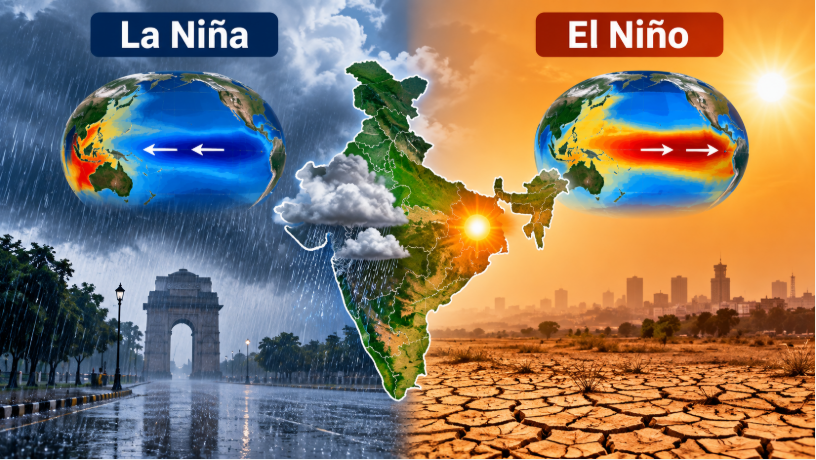
La Niña and El Niño are opposite phases of the El Niño-Southern Oscillation, a natural climate pattern that develops over the tropical Pacific Ocean. Both can influence weather conditions far beyond the Pacific, including rainfall patterns over India.
While La Niña is associated with cooler-than-normal ocean temperatures in parts of the tropical Pacific, El Niño represents the warmer phase. Understanding the difference is important when following India’s monsoon forecasts and seasonal weather developments.
La Niña vs El Niño
La Niña generally involves stronger trade winds and cooler Pacific waters. In many years, these conditions are favourable for India’s southwest monsoon.
El Niño, on the other hand, can weaken monsoon circulation and is often associated with below-normal rainfall in India. The IMD has noted that El Niño generally weakens the Indian summer monsoon, although the intensity of its effect can vary from one event to another.

Main Differences
- La Niña: Cooler tropical Pacific waters.
- El Niño: Warmer tropical Pacific waters.
- La Niña: Often supports stronger Indian monsoon conditions.
- El Niño: Often increases the risk of weaker monsoon rainfall.
- ENSO-neutral: Neither La Niña nor El Niño is dominant.
- Both patterns can affect weather around the world.
India’s 2026 Weather Situation
The beginning of 2026 featured weak La Niña-like conditions that were transitioning toward neutral conditions. The IMD subsequently warned about the possibility of El Niño developing during the southwest monsoon season.
The shift became important for India because the country was already facing rainfall concerns. Recent reports indicate that August 2026 rainfall was significantly below normal, while September was also expected to remain relatively dry in many areas.
The current El Niño conditions have therefore attracted greater attention than La Niña. The National Information System for Climate and Environment Studies has also reported that the 2026 El Niño is among the strongest recent events and that the Indian Ocean Dipole could influence its impact on India’s monsoon.
Why Farmers Are Watching Closely
Rainfall is crucial for India’s agricultural economy. A weak monsoon can affect soil moisture, crop growth, reservoir levels and irrigation availability. A prolonged rainfall deficit can also influence food supplies and prices.
Farmers therefore follow seasonal forecasts closely, particularly during the later stages of the monsoon and before winter crop planting begins.
What to Watch Next
Weather agencies will continue monitoring Pacific Ocean temperatures, atmospheric circulation and the Indian Ocean Dipole. These factors can change over time and may influence India’s rainfall and temperature patterns.
For readers following India’s weather, it is important to distinguish between the historical effects of La Niña and the current El Niño-driven situation in 2026. The distinction helps explain why rainfall expectations this year differ from the conditions typically associated with La Niña.
