
Table of Contents
Top Headlines
- India’s passenger-vehicle sales reached a record 4,39,309 units in August 2026, according to the Society of Indian Automobile Manufacturers (SIAM).
- Two-wheeler sales climbed to 20,34,698 units, while three-wheelers reached 93,764 units during August.
- Alternative-fuel vehicles including CNG, hybrids and EVs collectively overtook petrol/ethanol cars in August retail sales.
- CNG/LPG accounted for 25.28% of passenger-vehicle retail sales, followed by hybrids at 9.04% and EVs at 7.63%.
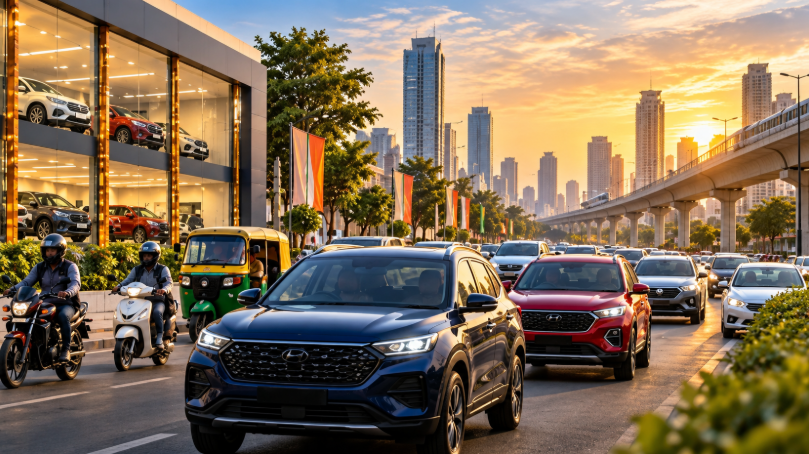
- India’s automobile market is entering the festive season with strong demand for SUVs, utility vehicles and two-wheelers.
- BMW India is preparing another price increase amid rupee depreciation and higher commodity costs.
- Hyundai has confirmed the Bayon SUV for India, adding another model to the country’s expanding compact-SUV market.
- Kia has opened bookings for the Carens CNG, Carens Clavis CNG and Carnival Hybrid.
- Electric-vehicle adoption continues to expand, with September registrations already showing strong activity.
- The Indian auto industry is increasingly focused on EVs, hybrids, CNG, flex-fuel technology and connected-car features.
India Automobiles News Today: Auto Sales Hit Record August Levels
India’s automobile industry is entering the second half of 2026 with strong sales momentum. Domestic passenger-vehicle sales reached a record 4,39,309 units in August, representing a 36.5% year-on-year increase, according to SIAM data. Two-wheelers also recorded strong performance, with sales reaching more than 20.34 lakh units.
The strong August performance came as consumers prepared for the festive buying season. However, industry analysts note that part of the year-on-year increase reflects a relatively weak comparison base from August 2025, when some buyers delayed purchases following the announcement of GST changes.
SUVs and Utility Vehicles Drive Demand
Utility vehicles continue to dominate India’s passenger-vehicle market. SUV and MUV demand has become an important growth engine for manufacturers, with utility-vehicle sales accounting for a large share of overall passenger-vehicle demand.
The trend is being supported by consumer interest in larger vehicles, improved road infrastructure, financing availability and the increasing number of compact and midsize SUVs available in the Indian market.

Manufacturers are therefore continuing to expand their SUV portfolios, while several new models and facelifts are expected to reach Indian showrooms.
CNG, Hybrid and EV Cars Gain Ground
One of the biggest developments in India’s automobile market is the changing fuel mix. In August, CNG/LPG, hybrid and electric vehicles together represented 41.95% of passenger-vehicle retail sales, compared with 40.85% for petrol/ethanol vehicles.
CNG remained the largest alternative-fuel category with a 25.28% share. Hybrid vehicles accounted for 9.04%, while EVs represented 7.63%. Diesel vehicles held a 17.21% share.
The figures indicate that Indian consumers are increasingly considering fuel economy, running costs and available charging or refuelling infrastructure when choosing vehicles.
Electric Vehicle Market Continues to Expand
India’s EV market remains an important part of the country’s automotive transition. September registrations are already showing significant activity, following a strong August in which EV registrations crossed the three-lakh mark according to Vahan-based data.
Automakers are introducing electric versions across different price categories, while charging infrastructure and battery technology continue to develop.
Companies such as Tata Motors, Mahindra, Hyundai, Kia and other manufacturers are expanding their electric portfolios, while new EV-focused companies are also entering the market.
New Cars and SUVs Coming to India
The Indian automobile market is seeing a busy product cycle. Hyundai Bayon has been confirmed for India, with the SUV expected to compete in the growing compact-SUV segment.
Kia has also opened bookings for the Carens CNG, Carens Clavis CNG and Carnival Hybrid, giving buyers more choices across CNG and electrified powertrains.
Meanwhile, manufacturers including Maruti Suzuki, Tata Motors, Mahindra and BMW are continuing to update their portfolios with new models, facelifts and technology upgrades.
BMW India Prices and Premium Car Market
BMW India is preparing another price increase as the company faces pressure from the weaker rupee and higher commodity costs. The automaker has already implemented several price revisions during 2026.
The premium segment is nevertheless seeing continued product activity, with BMW expanding its 7 Series range and introducing additional electric and technology-focused models.
Two-Wheeler Market Remains Strong
Two-wheelers continue to represent the largest volume segment of India’s personal-mobility market. SIAM reported 20.34 lakh two-wheelers sold in August 2026, up 10.5% year-on-year according to recent industry reporting.
Scooters are contributing significantly to the growth, while electric scooters are also gaining attention as manufacturers expand affordable models.
