
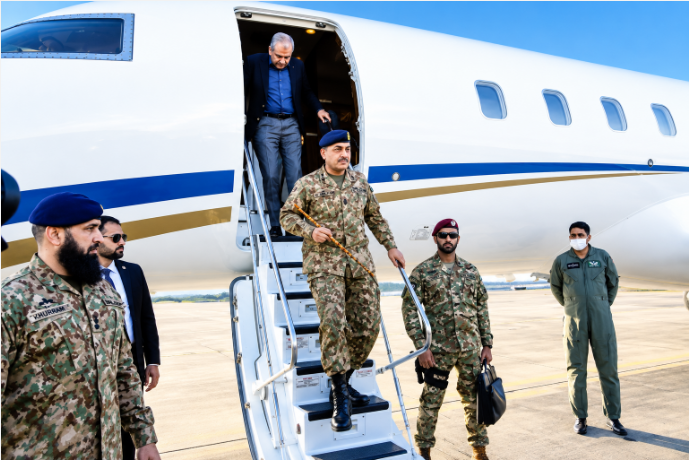
Pakistan’s military leadership is in the spotlight following a major restructuring of the country’s armed forces. Field Marshal Asim Munir, Pakistan’s Army chief, has become the country’s first Chief of Defence Forces (CDF), giving him statutory operational command over the Army, Navy and Air Force.
Key Headlines
- Asim Munir becomes Pakistan’s first Chief of Defence Forces.
- The new position gives one officer command across all three services.
- Munir continues to serve as Army chief.
- Pakistan has introduced a major change to its military command structure.
- The development has raised questions about civilian-military oversight.
- The military is also facing continuing security challenges.
The Defence Forces of Pakistan Act, 2026 created the CDF position and formally changed the way Pakistan’s armed forces are commanded. Under the new system, the CDF has operational command and control over the Army, Navy and Air Force and serves as a principal military adviser to the federal government on defence and national-security matters.
The change is being described as one of the most significant reorganisations of Pakistan’s military command structure in decades. Previously, the Chairman of the Joint Chiefs of Staff Committee was primarily responsible for coordination between the services and did not have the same direct operational authority over the Navy and Air Force.
Supporters of the reform say a unified command could improve coordination between Pakistan’s military services, particularly in areas such as drones, cyber operations and rapid responses to security threats. Critics, however, have raised concerns that concentrating authority in an Army-led position could increase the military’s influence over national decision-making.

The development comes as Pakistan continues to face security challenges on several fronts. The military has recently reported operations against militants in Balochistan and Khyber Pakhtunkhwa. According to Pakistan’s military, security forces killed 48 militants during several intelligence-based operations in Balochistan. The claim and the identities of those killed were provided by the military and have not been independently verified.
Pakistan has also reported clashes involving militants attempting to cross from Afghanistan. The military said 15 militants were killed in an operation in North Waziristan after an exchange of fire lasting around 36 hours. Pakistan has accused militant groups of receiving support from India, an allegation that India denies.
The expansion of Munir’s military role therefore comes at a sensitive time for Pakistan’s security establishment. With terrorism, border security and regional tensions remaining major concerns, the new command structure could play an important role in shaping the country’s defence policy.
For India and other neighbouring countries, developments within Pakistan’s military leadership will remain closely watched. Any changes in Pakistan’s defence policy could have implications for regional security and relations across South Asia.
