
Table of Contents
Top Headlines
- UPI payment rules are changing from October 15, 2026, with a 0.4% Merchant Discount Rate (MDR) on certain person-to-merchant transactions above ₹2,000.
- Person-to-person (P2P) UPI transactions will remain free, regardless of the amount transferred.
- Consumers will not directly pay the new MDR on eligible merchant transactions; the charge applies within the merchant payment ecosystem.
- MDR on general merchant transactions of ₹75,000 or more will be capped at ₹300 per transaction.
- UPI recorded 24.51 billion transactions worth about ₹29.82 lakh crore in August 2026, according to reported payment data.
- RBI and NPCI recently introduced UPI Tap & Pay, allowing compatible NFC-enabled phones to make payments at supported point-of-sale terminals.
- The new MyUPI platform uses AI-based technology to provide transaction information, safety controls and customer-support features.
- India is also exploring AI-agent payments, although safeguards and governance remain important considerations.
Payment System News Today: UPI Rules Enter a New Phase
India’s digital payment ecosystem is undergoing an important change as authorities introduce a selective Merchant Discount Rate (MDR) for certain UPI merchant payments. The new framework is scheduled to take effect on October 15, 2026, ending the blanket zero-MDR arrangement for some higher-value person-to-merchant transactions.
Under the notified framework, a 0.4% MDR will apply to eligible UPI payments above ₹2,000 made to merchants. The charge is part of the payment ecosystem rather than a direct transaction fee imposed on ordinary consumers. Person-to-person payments will continue to remain free.
The government has also clarified that UPI payments up to ₹2,000 will remain free, while eligible small merchants will receive protection under the new framework.
What the New UPI Charges Mean
The new rules are designed to apply selectively rather than across every UPI transaction. For general merchant transactions of ₹75,000 and above, the MDR will be capped at ₹300 per transaction. Certain sectors, including railways, telecom, insurance and fuel, are subject to a flat ₹5 charge under the reported framework.

The Reserve Bank of India has said the introduction of MDR on larger merchant payments can support investment in technology, infrastructure, security and wider acceptance of digital payments.
For consumers, the distinction between P2P transfers and merchant payments is particularly important. Sending money to another individual will continue to be free, while the new framework concerns selected merchant transactions.
UPI Continues to Grow Rapidly
Despite the debate over payment costs, UPI continues to expand at a significant pace. In August 2026, the system processed about 24.51 billion transactions worth ₹29.82 trillion, according to reported NPCI data. Transaction volumes increased both month-on-month and year-on-year.
The growth demonstrates how deeply UPI has become integrated into India’s payment system, covering everything from retail purchases and bill payments to bank transfers and online commerce.
The government has said UPI has also expanded internationally, with the system live in multiple foreign countries.
UPI Tap & Pay Introduced
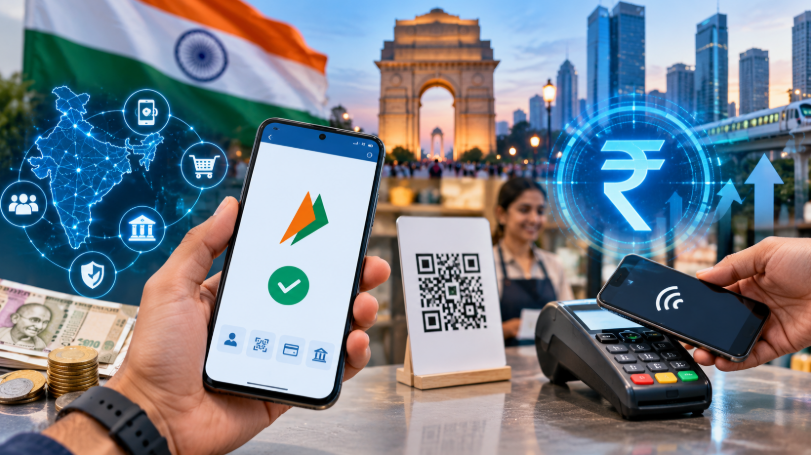
Another major development in India’s payment system is UPI Tap & Pay. The feature allows users with compatible NFC-enabled smartphones to make payments at supported POS terminals by unlocking their phone and tapping it on the terminal.
The feature can work without the smartphone itself having an active mobile internet connection because the POS terminal can provide the necessary connectivity. For smaller payments, transactions up to ₹5,000 can be completed without entering a UPI PIN under the announced functionality.
AI Enters India’s Digital Payment System
RBI and NPCI have also introduced MyUPI, an AI-powered support layer designed to give users a unified view of UPI transactions and AutoPay mandates.
Features include a safety switch for suspected unauthorised debits, additional information about beneficiaries, transaction replay and automated chargeback processing for eligible cases. Multilingual support is also planned.
India is separately preparing a framework for agentic payments, under which AI agents could potentially make small digital payments without requiring approval for every individual transaction. Reports indicate that safeguards are being considered before wider deployment
